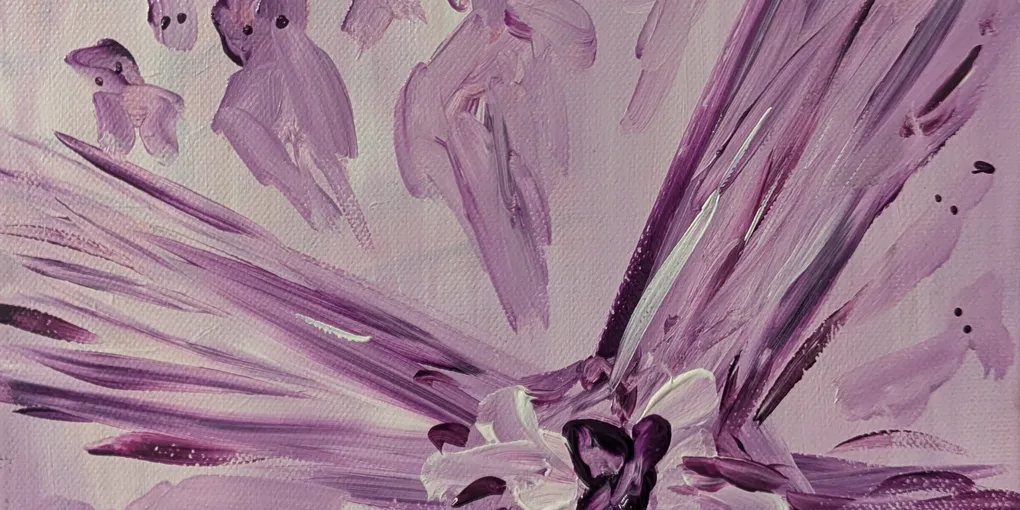
Reading of the Crown
Note on Translation: The original text was written in Italian rhyming verse. While every effort has been made, also leveraging AI, to translate the poem faithfully into English rhyming couplets while fully preserving its explicit and implicit meaning, certain subtle linguistic nuances and metric resonances of the original Italian may inevitably be missing. You can read the original work here: Lettura della Corona.
I step into the cave as one steps in a thought
not mine, but ancient, by the stone of mystery wrought.
The walls breathe very slowly, like wild beasts gone to sleep,
and the air tastes of words that no lips could ever keep.
Each step is but an echo that does not belong to me,
each shadow seems to know from whence it came to be.
And yet I venture forward, as though expected there,
as though the dark already held me in its silent care.
A light far in the distance, or perhaps a mere reflection,
invites my feet to follow a path of low subjection.
And when I truly think that I am lonely and obscure,
a voice enfolds me, thin and stern, yet remarkably pure:
“Who are you, you who cross the threshold of the void?
A name or recollection? Body or mind employed?”
I answer, though my voice is faint, half-lost within the hall:
“I am what still remains of an endless questioning’s call,
a step into the void, a fragile weave, a broken frame,
I am the one who even now answers to a name.”
The voice is hushed, and yet the heavy silence starts to grow,
like a sentence that is lingering and not yet let to go.
Then the air dissolves its freezing grip, the march begins anew,
as if the doubt itself defends and wounds me through and through.
I journey deeper down into the belly of all time,
where every second bends beneath a slow dismay sublime.
The walls contract around me, then widen out once more,
like breaths of worlds where nothing spills upon a foreign shore.
And finally I come upon a door carved in the stone,
not closed, not open, but its shape is faintly shown.
It has no handle to be grasped, no visible lock or key,
yet I feel it is accessible to an terrifying degree.
I touch it with a finger, and without a single sound
it yields, as if it waited for my error to be found.
Beyond the threshold, it is not the night that meets my sight,
but a vast and open brilliance that swallows all in light.
A library unfolds itself, immeasurable and still,
vaster than any dream, older than the void can fill.
It stretches to infinity, wherever eyes may look,
as if the world itself were but an index in its book.
Infinite shelves arise, columns of histories untold,
where every book’s a fragment of the lives and memories sold.
Four corridors open wide, a cross upon the floor,
like the cardinal points of a voice that speaks forevermore.
They meet right at the center, in a room designed as round,
where time itself is bent and where the sinking mind is drowned.
I walk along but one of them, suspended in the air,
between the fear of losing and of being known down there.
Every book looks down at me, each spine calls out my part,
but none pronounces truly my name or my life’s chart.
At last I reach the heart of that labyrinthine place,
where every new beginning is an indistinct embrace.
A circular room appears, perfect and utterly mute,
like a question that no seeker can ever quite refute.
At the center stands a lectern, ancient and severe,
supporting a book as large as thought itself when near.
The pages tremble, alive and restless in their sheets,
as if they breathed the secrets of destinies and meets.
A figure stands right there, or a watching shadow grown,
with eyes that time itself has never preserved or known.
And once again the question comes, slower, clear and high:
“Who are you, you who reach the threshold few come by?
Are you the written or the writer? The end or the start?
Are you an error of blind chance or a steep, eternal part?”
I feel the heavy weight of every unsaid word,
and I answer, like a sailor whose imperfect course is stirred:
“I am nothing but the step between that which becomes,
a voice that ever seeks but never holds what it hums,
I am the echo of a name that escapes the rigid mold,
I am the doubt that’s born and never changes to be old.”
The figure nods its head, or perhaps it starts to lean,
then opens wide the book with a care that is divine.
It turns the heavy pages, slow and deep into the night,
like one who searches through infinite waves for what is right.
Every leaf appears to tell of a face that once drew breath,
every line a destiny never fully reaped by death.
Then it stops and looks at me with an eye that is severe,
like one who weighs the entire invisible that is here:
“I seek you among signs, among traces and among threads,
among the fallen names and where eternal exile treads,
but tell me, wanderer, and speak without a trace of dread:
are you written in the book or are you just a mistake instead?”
I answer, trembling, yet I do not lie or hide:
“If I am an error, then it is in having failed inside
that I find my true form, that I find my open way,
for nothing is more real than the shadow cast today.
If I am written down, I do not read the plot,
but I feel that something calls me still, though I know it not.”
A long and heavy silence, vaster than the sea can grow,
envelops the whole room without a word to show.
Then the figure, with a sudden and unexpected stride,
plucks from the book a single volume kept inside.
It extracts it as one pulls a destiny away from sight,
as one tears time itself from its path of steady flight.
And holding it aloft, toward the great unknown,
offers it to heaven, to the emptiest void shown.
And then that happens which no human name can ever bear:
a hand descends from high, completely formless in the air,
and takes the book into itself, accepts it and conceals,
as if the sky itself were the canvas it reveals.
A tremor passes through the infinite shelves along the wall,
like a single breath that stirs within the lost worlds of them all.
The figure closes tight the massive volume in its place,
and the air grows dense and heavy, a dark and misty space.
Then it looks at me, but now without judgment in its eyes,
like one who has concluded an ancient torment’s sighs.
And finally it speaks, with a voice that heavily weighs:
“Not every presence merits the waiting of the days,
not every question finds a home where it can stay,
and you, who have arrived, must now go on your way.”
I remain completely still, my heart suspended there,
like one who found the prize but could not understand or share.
And I answer, with a voice that is weaker, yet is true:
“If I must go away, tell me at least the evening due
in which I shall return, or if I’ll ever return to see,
if this journey truly ended or began its course for me.”
The figure sighs aloud, or perhaps it fades from view,
like a star that can no longer support its burning hue.
And it replies in rhyme, with a tone detached and cold:
“He who seeks returns is lost at once, so I am told,
he who asks for answers will surely lose the track,
for every single turning is a mystery coming back.
You are neither expected nor held within this place,
you are only a passage, a lived threshold in space.”
The lights begin to dim, the world begins to bend,
like a page that time disowns and brings unto an end.
And without understanding if it’s a dream or destiny,
I find myself beyond, on the first path set for me.
The cave is now behind, or perhaps it lies ahead,
but my footsteps now sound different, distant where I tread.
I turn around a moment, but nothing there remains,
only the silent distance of far and fading planes.
And yet within my soul something is deeply traced,
not a memory, not an advice precisely placed,
but the echo of a voice that resounds and will not cease:
“Who are you?”—and the question never leaves my mind in peace.
Liked it?
Subscribe to the newsletter to receive the next ones in your inbox as soon as they get published. It's free.